
mainstage series
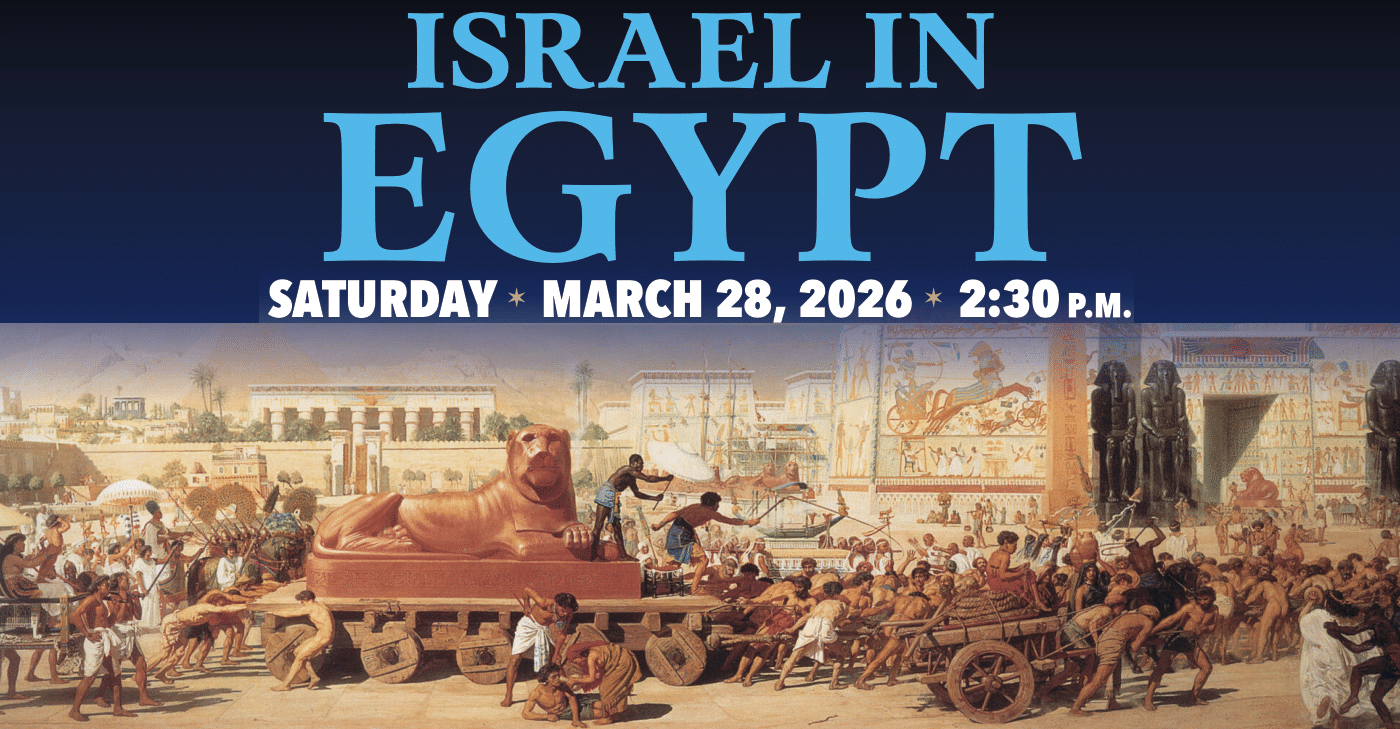
Saturday, March 28, 2026 • 2:30 p.m.
First Free Methodist Church (3200 3rd Ave W, Seattle)
Harmonia Orchestra & Chorus
William White, conductor
- tickets will also be available at the door, beginning at 1:30 p.m.
Program
George Frideric Handel (1685–1759)
Israel in Egypt, HWV 54
- full concert program (PDF)
About the Concert
Handel’s Israel in Egypt is a paramount piece in music history: it’s the twin sibling of Messiah and the work that inspired Haydn (and thus several generations of composers in his wake) to get into the oratorio game. It’s also a piece of Harmonia history, having been performed 10 times over the course of our organization’s 56-year existence. This will be a revival for the ages and is sure to become a new favorite of recent Harmonia converts.
- This performance will last approximately one hour and 50 minutes, including one intermission.
- Join William White for a pre-concert talk beginning at 1:30 p.m.
- This concert is also being livestreamed.
Maestro’s Prelude
Dear Music Lover,
If you’ve been a fan of Harmonia for years, you almost certainly know that our organization is renowned for performances of Handel’s Messiah. But if you’ve been a fan for decades, then you’ll know that in the group’s early years, it was Handel’s second-most-popular oratorio, Israel in Egypt, that formed the backbone of our repertoire.
The ensemble’s founder, George Shangrow, led his first performance of Israel in Egypt at a concert on Monday(!) April 23, 1973, and followed it up the next year with a second performance on April 21. It appeared again in February 1976, October 1977, October 1980, October 1984 and May 1989. After an eight-year gap, Maestro Shangrow performed the work only two more times prior to his death in 2010: October 1997 and April 2002.
Harmonia has mounted one additional performance since then, in April 2015, conducted by George’s longtime friend Roupen Shakarian (who sang in some of the early performances) and the only time the group presented the controversial three-part version. This afternoon we restore Maestro Shangrow’s practice of staging the two parts that Handel himself presented after the work’s premiere.
If you’re keeping score, you’ll have noted that today’s performance is the group’s 11th, which you might be surprised to learn outranks much more familiar fare such as Bach’s St. John Passion (9) and Mass in B minor (9), the Mozart Requiem (7) and Brahms’ German Requiem (6). This all raises the obvious question: why would a young George Shangrow (who was 19 when he founded the group) return time and again to such an obscure piece?
I never knew George myself, but I can guess at a couple of answers. First off, when George started tackling Israel in Egypt, the piece was not nearly as obscure as it is today; in the 19th century, the oratorio received nearly as many jumbo-wide festival performances as did Messiah. Secondly, it may have had to do with George’s youth, because this piece is a romp through every musical jape that Handel can shake a stick at. Finally, it was just a really canny move on George’s part — when you’re trying to establish your reputation, it makes sense to define your group’s identity with something off the beaten path.
Whatever the reason(s) may be, I am proud to continue this glorious tradition today, and I hope you will enjoy yourself very much.
— Will White
P.S. The last time this group was performed Israel in Egypt, the concert directly adjacent to it featured Gustav Holst’s The Planets. By sheer coincidence, the same is true this year, and so we hope that you will join us at Benaroya Hall on Friday, May 8 to hear that magnificent, colorful masterpiece, in the sonic splendor of our city’s major concert venue.
Program Notes
George Frideric Handel
Israel in Egypt, HWV 54
Handel was born in Halle, Germany, on February 23, 1685, and died in London on April 14, 1759. He composed the music heard this afternoon between October 1 and November 1, 1738. It received its first performance at the King’s Theatre in London on April 4, 1739. In addition to double chorus and vocal soloists, the work employs 2 oboes, 2 bassoons, 2 trumpets, 3 trombones, timpani, continuo and strings.
Georg Friedrich Händel, the son of a respected barber-surgeon and a clergyman’’s wishes that he study law), there is some question as to whether he actually attended any classes. Even though he was Lutheran, he served for a year as organist at the Calvinist Cathedral in Halle before moving to Hamburg, where he played second violin and harpsichord in the city’s opera orchestra.
In Hamburg, Handel forged what would become lifelong friendships with composers Georg Philipp Telemann and Johann Mattheson (in spite of a 1704 disagreement that led to Mattheson nearly killing Handel in a duel) and by 1705 had composed his first opera, , written (as was the fashion at the time) in the Italian style; three more (now mostly lost) quickly followed.
In the latter half of 1706 Handel headed to Italy (at the invitation of Prince Ferdinando de Medici, according to legend — if not fact), stopping in Florence and by the end of the year arriving in Rome. Unfortunately for Handel, who presumably sought to learn the art of Italian opera, an ongoing papal ban on staged performances forced him to instead compose liturgical music (including his Dixit Dominus, presented by Harmonia in November 2024) and at least 60 chamber cantatas during his visits to the Eternal City. He did, however, produce two operas during his years in Italy: Rodrigo debuted in Florence in October 1707, and Agrippina was a smash hit in Venice in January 1710, the Venetians hailing il caro Sassone (“the beloved Saxon”).
Upon his return to Germany, Handel made a stop at the court of Georg Ludwig, Elector of Hanover, whose mother, Sophia, wrote about “the music of a Saxon who surpasses everyone who has ever been heard in harpsichord-playing and composition.” The elector was similarly impressed and within 10 days had hired Handel as his Kapellmeister. Sophia, it so happened, was a granddaughter of James I of England and 56th in line to the British throne, currently occupied by her first cousin, Queen Anne. But the 55 men and women ahead of Sophia were Catholic, so the British Act of Settlement of 1701 (which ensured a Protestant monarch) made her Anne’s heir. Thus when Handel, upon gaining employment from Georg Ludwig, immediately requested a year’s leave of absence to visit London, the Elector of Hanover may have been motivated to acquiesce through a desire to curry favor there, or perhaps to have an employee who could report back on the goings-on at the court of Queen Anne.
In London, where Italian opera was just coming into vogue, Handel made a splash with several works that premiered at the Queen’s Theatre on Haymarket Street. Between occasional trips back to Germany, he also composed an Ode for the Birthday of Queen Anne and other works with political overtones (such as the Utrecht Te Deum and Utrecht Jubilate). Upon Anne’s death on August 1, 1714, just weeks after the passing of her cousin Sophia, Georg Ludwig ascended to the British throne as King George I. The new monarch inherited the court composers of his predecessor, so Handel had no official position in spite of George I previously being his de facto employer, but he remained in London with the king’s blessing and occasionally composed at his request, most notably the Water Music of 1717.
Over the next decade, Handel continued to produce highly successful operas for Haymarket. On February 20, 1727, the House of Lords passed legislation naturalizing the German composer and George I granted his assent, making Handel a British citizen. When George I died less than four months later, his son ascended to the throne as George II. Ordinarily, any new music for a coronation ceremony would have been the responsibility of the Organist and Composer of the Chapel Royal, but after that gentleman died, London newspapers reported in early September that “Mr Hendel, the famous Composer to the opera, is appointed by the King to compose the Anthem at the Coronation which is to be sung in Westminster Abbey at the Grand Ceremony.” Handel actually composed four anthems for the occasion, including Zadok the Priest, which has been featured at each subsequent coronation ceremony for a British monarch (including that of King Charles III in 2023).
From Rinaldo in 1711 to Deidamia in 1741, Handel composed some three dozen Italian-language operas for English audiences. A typical opera season extended from November to June, with Handel introducing one or two new operas each year, along with revivals of past successes and (beginning in 1734) the occasional pasticcio assembled from music of other composers. In 1733, Frederick, Prince of Wales (the future George III), helped establish the Opera of the Nobility, which competed with Handel’s Royal Academy of Music (backed by Frederick’s parents, King George II and Queen Caroline). Beginning with the 1734–1735 season, the Nobility Opera took up residence in the Haymarket, forcing Handel to move to Covent Garden. At the same time, Handel also began to face competition from English-language operas (by Thomas Arne and others) that appealed to a wider public. These circumstances helped spur Handel’s transition to a brand-new genre: English-language oratorio.
Handel had composed a pair of oratorios (essentially unstaged operas, often on religious or mythological themes) during his time in Rome. Around 1718 he wrote a pair of English-language masques, Esther and Acis and Galatea, while under the employ of the future Duke of Chandos. In 1732, a London troupe unaffiliated with Handel mounted a production of EstherAcis, prompting Handel to present his own production of that work, featuring no stage action (not an artistic choice, but rather the result of a decree that forbade theatrical presentations of biblical tales).
The following season Handel premiered one Italian opera (Orlando) alongside two new English oratorios: Deborah (in London) and Athalia (in Oxford). Now considered a masterpiece, Orlando ran for 10 performances but failed to generate enough excitement to warrant a revival by Handel — it was not performed again until 1922. Deborah, on the other hand, with a double chorus and an expansive orchestra featuring trumpets and drums, fared better. Handel would continue to focus on opera for the next few years, but the commercial viability of oratorio had been established.
On April 13, 1737, Handel suffered some sort of stroke. A month later, the London Evening Post reported: “The ingenious Mr. Handell is very much indispos’d, and it’s thought with a Paraletick Disorder, he having at present no Use of his Right Hand, which, if he don’t regain, the public will be deprived of his fine Compositions.” Near the conclusion of a money-losing opera season, he traveled to the vapor-baths at Aix-la-Chapelle (now known as Aachen, Germany). Eventually restored to health, several months later he returned to London, where the opera season was already underway, and made plans to compose two operas and a pasticcio. Then, on November 20, the death of Queen Caroline closed theaters for a six-week period of mourning.
On December 7, the royal family commissioned a funeral ode from Handel, who produced The Ways of Zion Do Mourn in under a week. The work was premiered at the queen’s funeral in Westminster Abbey on December 17, after which Handel turned his attention to completing his two new operas, Faramondo and Serse“But Handel had seen the warning signs in time,” writes Christopher Hogwood; “two days earlier he had started work on the oratorio Saul.” Working from a libretto prepared by Charles Jennens (who would later provide the text for Messiah), Handel spent two months writing the music, some of which was reworked from his earlier compositions and a decades-old Te Deum by the Italian composer Francesco Urio. Initially, he had planned to incorporate much of his Funeral Ode for Queen Caroline into Act III, but eventually composed new music for this episode.
Handel then launched into another biblical project: Moses’ Song, a choral anthem setting the text of Exodus 15, a song of praise to God for liberating the Israelites from the Pharaoh. The scope of the work soon expanded, with Moses’ Song (which Handel completed in a mere two weeks) becoming the conclusion of a tripartite oratorio, Israel in Egypt. Handel finished the second section (Exodus, recounting the Ten Plagues of Egypt and the parting of the Red Sea) in another two weeks, and reworked his Funeral Ode for the first part as Lamentations of the Israelites for the Death of Joseph. (The librettist remains unknown, although the most likely candidate is Jennens.)
The Funeral Ode was not the only pre-existing material Handel employed in Israel in Egypt. In addition to the aforementioned Urio Te Deum that had found its way into Saul, he also drew upon large swaths of a serenata (’io miri?) by Alessandro Stradella and a Magnificat for double chorus by Dionigi Erba, which Handel had copied out during his Italian sojourn three decades prior. (Not to mention a pair of his own harpsichord fugues and still more works by other composers.)
Handel presented his first oratorio season at the King’s Theatre across 12 dates from January through April of 1739. The first of six performances of Saul took place on January 16. New presentations of the ode Alexander’s Feast and his 1707 Italian oratorio followed in February and March, respectively. Finally, on April 4, Israel in Egypt premiered.
The first audience to hear Israel in Egypt was shocked at the sheer number of choruses in the oratorio, perhaps expecting a succession of virtuosic arias, to which they had become accustomed in Handel’s operas. And a segment of the population was still uncomfortable with biblical texts in the theater, even without sets, costumes or stage action. Even the organ concertos that Handel interspersed throughout the work (he was a renowned virtuoso on the instrument) could not win over the opening-night crowd.
Handel replaced several choruses with arias sung by an Italian soprano for a second and final performance, which found at least one ardent supporter with the initials A.Z., who wrote a letter to the editor of the Daily Post praising the oratorio to no end. “I must beg leave, by your means, to convey not only my own, but the Desires of several others, that [Handel] will perform this again some time next Week.” Handel acquiesced, and on April 17 the Prince and Princess of Wales were in attendance for a third and final performance, which prompted another letter to the Daily Post, this time by one R.W., that further extolled the work’s virtues. On May 10, the (actual) final 1739 performance of Israel in Egypt took place under the auspices of the Academy of Ancient Music, but with only the first and third parts.
In hindsight, the Academy excised the wrong part. Eventually it was the first segment, with its rather tedious lamentations on the death of Joseph, that proved the least-popular element of Israel in Egypt. The definitive version now consists of the second and third parts only. “Nobody had written anything quite like Israel in Egypt before,” says Handel biographer Jonathan Keates, “and its singularity, both in form and expression, placed it beyond the intellectual grasp of Handel’s contemporaries, for whom he was seldom inclined to revive it.”
After writing his final two Italian operas, Handel composed at least one oratorio each year from 1742 (Messiah) through 1752 (Jephtha). Around this time, his eyesight began to fail and he produced little if any new music thereafter.
A Handel oratorio typically begins with an instrumental overture or grand chorus, but due to the omission of the Funeral Ode, Israel in Egypt now opens in media res, with a stage-setting tenor recitative (an expository recitation of text resembling speech by a solo singer with spare accompaniment, usually a harpsichord and single cello) leading directly to a solo alto, who begins a double chorus (“And the children of Israel sigh’d”) that juxtaposes lamenting phrases about the plight of the Israelites (listen for the sighing violin phrases in response to the word “sigh’d”) with more vigorous passages detailing their oppression.
Another tenor recitative leads to “They loathed to drink in the river,” the music for which comes from an A-minor keyboard fugue (HWV 609) that Handel composed around 1716. Although not a strict tone-row in the Schoenberg sense, the fugue subject incorporates all 12 pitches of the chromatic scale, its wide leaps and strange intervals mirroring the revulsion and queasiness of the Egyptians at the prospect of drinking blood-laden water. Handel now beings a survey of the 10 plagues with the only aria in this part of the oratorio. A dotted-rhythm melody in the violins depict frogs leaping about as a solo alto describes the first three plagues. Frogs continue to jump in the strings as she mentions “blotches and blains.”
The lower choral voices, supported by trombones and woodwinds, intone “He spake the word,” then violins scurry about with racing thirty-second notes depicting “all manner of flies.” The vocal phrases get passed around the double chorus as lice and locusts descend, capped by a coda featuring oboes and bassoon.
Handel drew upon the opening sinfonia and a bass aria from the aformentioned Stradella serenata for the Hailstone Chorus, which begins quietly with a few isolated drops of precipitation but quickly evolves into a full-fledged downpour. Trumpets and timpani reinforce the exclamations of the double chorus.
The rather lighthearted tour through the first seven plagues takes a sudden turn with “He sent a thick darkness,” as the four-part chorus, in hushed tones, shifts through an ever-changing key center that evokes the sensation of wandering about in the dark.
Another of Handel’s early keyboard fugues (HWV 605, in G minor but here transposed to A minor) forms the basis for the dramatic double chorus recounting the smiting of the first-born Egypt, with percussive orchestral notes graphically depicting death blows.
The plagues now complete, Handel again utilizes an aria from the Stradella serenata as the basis for a gentle chorus describing the Israelites being brought forth “like sheep,” accompanied by pastoral strains from the orchestra, which glimmers for the mention of “silver and gold.” Bolder choral statements underline the lack of even “one feeble person among their tribes.”
“Egypt was glad,” with Egyptians expressing relief, first in legato tones, the music becoming more vigorous as they recall the fear they experienced during the plagues.
The next sequence begins with a choral declamation about the parting of the Red Sea, which leads to a fugue taken from Handel’s early Dixit Dominus (with a plunge of a seventh corresponding to each instance of the word “deep”). Running sixteenth notes evoke the Israelites scurrying across the seabed “as through a wilderness.”
A soprano aria (“It is the Lord that ruleth the sea”) from one of Handel’s earlier Chandos Anthems forms the basis for the conclusion to this sequence, a furious chorus with pounding timpani as the waters of the Red Sea overwhelm the pursuing Egyptians. The first part closes with a grand choral statement that yields to a solemn concluding double chorus based on a Stradella soprano aria.
The second part, Moses’ Song, begins with a stately instrumental introduction leading to a brilliant, energetic fugue that sings “unto the Lord” and celebrates “the horse and his rider” (accompanied by a galloping figure in the orchestra) being “thrown into the sea.”
A duet and chorus from the Erba Magnificat form the basis for a soprano duet and grand chorus in praise of the Lord, capped by a old-style fugue on “I will exalt Him” (inspired by a Gabrieli ricercare). Next, two basses attempt to outdo each other in recalling the end of the Red Sea sequence; here Handel combines an instrumental passage from the Urio Te Deum with vocal material from the Erba Magnificat. The chorus continues with a more solemn reminiscence of that episode (“The depths have covered them”) with deep notes in orchestra evoking “they sank into the bottom as a stone”; this is also based on Erba, as is the next trumpet-and-drums chorus (“Thy right hand, O Lord”). A brief declamation leads to a grand fugue (“Thou sentest forth thy wrath”), again drawn from Erba, as is “And with the blast of thy nostrils,” in which sopranos singing “the floods stood upright as an heap” lead to basses singing “and the depths” two-and-a-half octaves below.
There follows a pair of arias: The first has a tenor celebrating the vanquishing of enemies with militaristic bravado, the second (for soprano) features a rising-and-falling sixteenth note accompaniment from lower instruments that suggests the blowing of the wind. This leads to another declamatory chorus and fugue (once again taken from Erba). A contemplative duet for alto and tenor (more Erba) gives way to a minor-key chorus with dotted-rhythm accompaniment, followed by the work’s final aria (“Thou shalt bring them in”), as an alto celebrates the arrival in the promised land.
The final sequence alternates two statements of a grand trumpet-and-drums chorus (“The Lord shall reign for ever and ever”) with tenor recitatives, then concludes with a reprise of the “horse and his rider” chorus that opened Moses’ Song.
—Jeff Eldridge