
chamber music
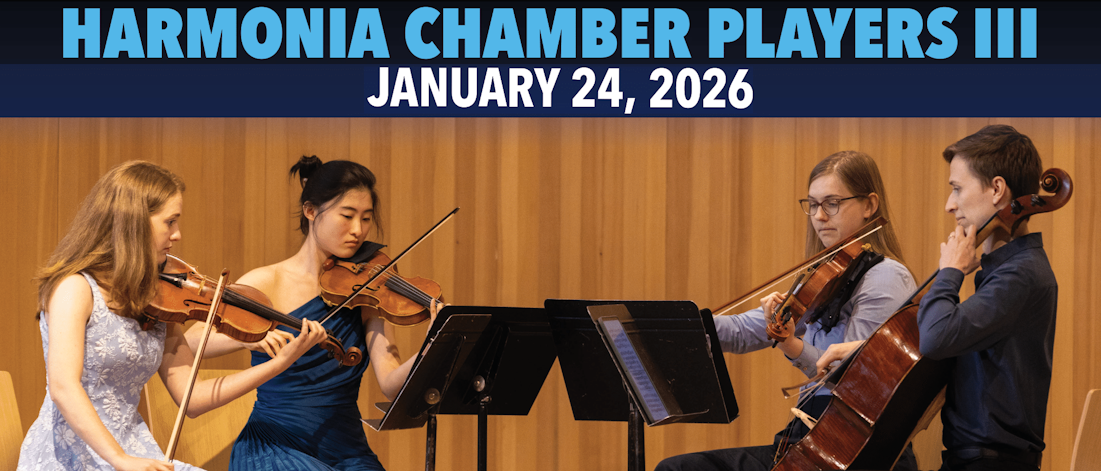
Saturday, January 24, 2026 • 2:00 p.m.
First Free Methodist Church (3200 3rd Ave W)
William White, conductor
Hsing-Hui Hsu, conductor
Tickets will also be available at the door, beginning at 1:30 p.m.
Program
Antonín Dvořák (1887–1979)
Serenade for Wind Instruments in D minor, Op. 44
Sheila Bristow (*1969)
Quatre mouvements pour un éventail [world premiere]
Franz Joseph Haydn (1732–1809)
Symphony No. 52 in C minor
About the Concert
The Harmonia Chamber Players expand into the Harmonia Chamber Orchestra for this intimate performance of extravagant masterpieces.
- full concert program (PDF)
- This performance will last approximately 80 minutes, including one intermission.
Program Notes
Antonín Dvořák
Serenade in D Minor, Op. 44
Dvořák modeled both of his serenades — the Op. 22 for strings and this Op. 44 — after the Classical-era serenades and divertimenti of Mozart and Haydn, works for chamber ensembles or small orchestras consisting of dance movements yet sometimes with aspirations toward a symphonic scale. In particular, the instrumentation of Dvořák’s Op. 44 recalls the harmonie ensemble so prevalent in the previous century: pairs of oboes, clarinets, horns and bassoons, often with an ad libitum part for string bass or contrabassoon — Dvořák uses both, along with an extra horn and a single cello. As with his string serenade, Dvořák worked quickly, sketching and orchestrating the opening movement in a single day (January 4, 1878) and completing the other three within two weeks. The premiere did not take place until November 17 of that year, in Prague. During the interim, Dvořák wrote his Slavonic Dances, whose publication in late November would create a sensation across Europe, turning a rather obscure Czech composer into a household name. Although Dvořák originally planned to write three serenades, he ended up using sketches for a third such composition in his Czech Suite, composed the following year.
The Op. 44 serenade opens with its shortest movement, a march. While Dvořák labels the next movement a minuet (in F major) with a trio (in B♭), the forms in question are actually two triple-meter Bohemian folk dances: the sousedská (in moderate tempo) and furiant (very fast, with syncopated cross-rhythms). The key moves to A major for the slow movement that follows, returning to D minor for the finale. Cast in a modified rondo form, this last movement charges ahead until relaxing for a meno mosso section that builds forcefully in anticipation of a recapitulation — but it is the march theme from the first movement that reappears before the opening theme of the rondo returns, now in D major.
Shelia Bristow
Quatre mouvements pour éventails
Sheila Bristow’s newest work, for string orchestra, consists of four brief sketches inspired by Paul Claudel’s Cent Phrases pour éventails. “The cent phrases of the title actually number 172,” writes Barry Laine, “and they are short poems written in French with accompanying Japanese characters” during the 1920s, when Claudel was the French ambassador to Japan. Modeling his verse on haiku, Claudel “also made the graphic qualities of each poem — its appearance on the printed page — an integral part of the poetic experience.”
Franz Joseph Haydn
Symphony No. 52 in C minor
Haydn composed the majority of his 100-plus symphonies while in the employ of the wealthy Esterházy family. “My prince was satisfied with all my works,” he recalled, “I was applauded and as leader of an orchestra I could experiment, observe, eliminate, dare.” When Prince Nikolaus would spend months at a time at his Eszterháza estate (modeled after Versailles), the composer “was cut off from the world. No one around me could have doubts about me or torment me, and I was forced to become original.”
Dating from 1770 or 1771, the Symphony No. 52 has been called by Haydn scholar H.C. Robbins Landon, “the grandfather of Beethoven’s Fifth Symphony, also created with mathematical precision and in extreme conciseness,” and, according to YouTube sensation Dave Hurwitz, stands as “one of the very greatest — if not the greatest — of the Sturm und Drang symphonies” that Haydn composed around this time. (This “storm and stress” label is a misnomer, applied by a French musicologist who was unaware that Haydn’s minor-key symphonies of this era predated the same-named literary movement by several years.)
“The opening movement,” notes Daniel Jaffé, “is one of the most dramatic and disconcerting that Haydn ever composed: just try predicting the phrase lengths or where the each cadence is going to fall!” An E♭-major second subject is, unusually, heard twice, the second time at great length.
The Andante, in 3/8 time and C major, presents itself as a gentle dance with muted violins, but offers humorous and disconcerting surprises along the way. The minuet returns to C minor and features unexpected accents on beat three of its 3/4 meter; oboes lead the way in the gentler C-major trio section. In the Presto finale, Haydn makes highly effective use of built-in pauses and energetic counterpoint.